Read to your children, and give them books to read. The need for children to read and hear stories is vitally important.
But not just any stories will do.
It is important that they read the right kind of stories.

Just as children need to eat the right kind of food, they also need a healthy diet of the right kind of stories. It’s probably obvious that if there are the right kind of stories, there are also the wrong kind of stories. I am not necessarily talking about “bad” books full of wickedness, filth, and vice—although they are also the wrong kind of stories, and available in abundance. (Check out the young adult or even children’s section in your local Barnes and Noble bookstore if you need convincing.) It’s not the blatantly wicked content of bad books that I’m speaking of here, but the wrong kind of stories in the sense of what they don’t encourage, inspire, and teach.
Stories are powerful. We see ourselves in them. They shape the way we see the world around us. We were created by the Great Storyteller for stories. We live in the midst of the greatest of stories. Skillfully crafted stories that we read (especially as children) have the ability to instill within us far-reaching insights into the essence of life, insights that are not easy to attain by other means.
Eustace Scrubb
Take Eustace Scrubb for example, a boy who had read only the wrong books. C.S. Lewis tells us that the books he had read “had a lot to say about exports and imports and governments and drains, but, they were weak on dragons.” This young fellow had been raised to snub things like imaginative adventure stories as pointless and time-wasting, and stick to dry and practical books.
We are introduced to Eustace in the first sentence of The Voyage of the Dawn Treader, the fifth book in Lewis’ Chronicles of Narnia series. One of my favorite lines in the entire Narnia series is the first line of this book which says simply, “There was a boy called Eustace Clarence Scrubb, and he almost deserved it.”
Scrubb truly was a miserable and nasty boy, a “know-it-all”, exemplifying laziness, self-centeredness, and even dishonesty. In this book he is certainly not a character who would be admired or emulated. Lewis makes it clear from the beginning of the story that a large part of the reason for his demeanor and character was that he had not read the right kind of books. He did like books “if they were books of information and had pictures of grain elevators or of fat foreign children doing exercises in model schools.” But when, in the story, he suddenly finds himself caught up in a real, bona fide adventure, full of things like sea-faring ships, a prince, talking animals, magic, and even dragons, he was completely at a loss, and unprepared to handle it. He might have known a lot of facts, but he knew nothing of courage, of valor, of chivalry, of conquering, of taking risks, of discipline, of defending, of self-sacrifice, of adventure… of the stuff of life.
Dragons and the Like
Think about a good dragon story. We aren’t scratching our heads trying to figure out who the good guys are, and what is evil and needs to be defeated. We aren’t lost in self-realization, gazing deeply inward to find our identity.
The scenario might go something like this. There is a quiet little kingdom with surrounding villages, full of hard working and decent folk, living their lives and tending to their own business. Suddenly, out of nowhere, a terrible fire-breathing dragon sweeps in and wreaks havoc upon them, taking them completely by surprise. The ferociously strong and wicked dragon steals any and all treasure from the kingdom to hoard in his lair, levels homes and barns, killing and destroying anyone and anything in his way. He even rushes into the castle and steals the beautiful princess away from her people, whisking her off to live with him in his terrible mountain lair. He disappears for periods of time, but suddenly reappears whenever he wishes to steal, kill and destroy some more.
Finally, in due time, a mighty warrior unexpectedly appears on the scene. He sees the terrible circumstances of these poor people, hears of the plight of the beautiful princess, and courageously (though with much trepidation) determines to do something about it. He might receive help and direction from a wise wizard, or some sort of other-worldly character. But eventually, the day comes when he girds on his armor and his sword, and goes out to bravely fight and destroy the wicked beast and rescue the princess, or die trying.
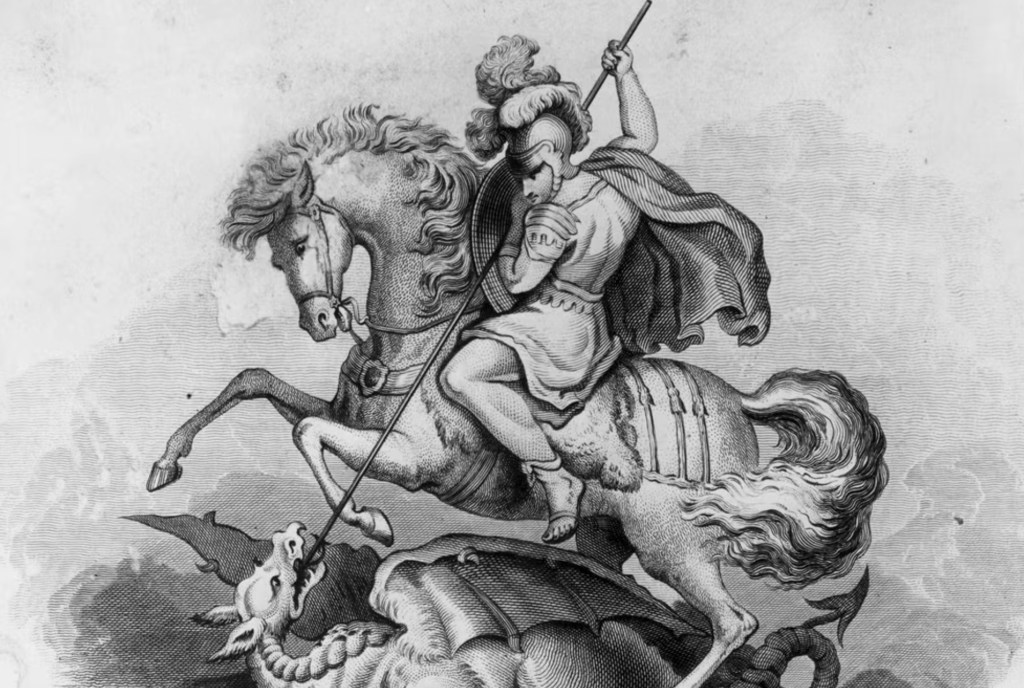
After a terrible fight, the battle-wounded and weary warrior finally has the victory over the dragon, barely killing him at the last minute, saves the princess, and brings back all of the treasure the dragon had stolen from the kingdom. Of course, he eventually marries the beautiful princess, and the people of the kingdom have a yearly celebration in remembrance of the coming of the brave and mighty warrior who saved them from their terrible enemy. I’m sure you have read stories such as this before.
The Story of Stories
As previously mentioned, we are living in the greatest story ever written. A dragon did come into the world you and I are living in right now. He seduced and deceived the first man and woman in the garden at the creation of our world. They gave heed to the old serpent and tempter, rebelliously disobeying the clear word of God, and the whole creation fell into chaos. In that terrible day, in God’s story, the dragon had the victory, and he stole away the wonderful creation that God had made. An unimaginable world of light and goodness became a place of darkness, thorns, pain, and death.
But even on that very dark day, God spoke directly to the dragon, almost as if looking him in the face, eyeball to eyeball, and spoke these words:
I will put enmity between you and the woman, and between your offspring and her offspring; he shall bruise your head, and you shall bruise his heel.
Genesis 3:15
This all meant that there was going to be a great battle—the battle of the ages—between light and darkness. It is the battle between the seed of the woman (the virgin birth of Christ) and the seed of the serpent (children of the devil).
God made a promise that day in that garden. He told the dragon that he was going to bruise the heel of this warrior who was to come, but the warrior was going to bruise the dragon’s head (something much worse). The Messiah/Savior to come will be bruised, but he is going to turn around, put His foot on the neck of the dragon, and give him a mortal head wound.
When the first woman Eve had her first son, I believe she was hopeful that this was the savior of the world! But her hopes were dashed, as we see in the terrible account of Cain. Many women through the centuries following would have been hopeful that the promised seed might come through them. But He would not come until the Virgin Mary birthed Him in Bethlehem’s stable thousands of years later. That’s what the announcement of the angels was all about when they said those now infamous words to the shepherds.
For unto you is born this day in the city of David a Savior, who is Christ, the Lord.
Luke 2:11
That little baby, Jesus, grew up and demonstrated who He was. He told the reason for which He had come. The children of evil eventually took the Savior of the world and bruised Him, nailing Him to a cross… thinking they had won. The dragon thought he had won. Little did they know, this was the plan of the ages. The greatest victory in the world was taking place on that cross. The Savior had been bruised, but three days later He rose from the dead, victorious over sin, death, and the grave, and dealt a blow to the dragon that was mortal. He paid the price for sin, and took back the deed of the earth. Before going to the cross, He stated:
Now is the judgment of this world: now shall the prince of this world be cast out. And I, if I be lifted up from the earth, will draw all men unto me.
John 12:31-32
He had come to save, not just a single kingdom, but the whole world from the damage that had been brought in by the dragon.
The baby in Bethlehem is now the living Savior for all who will place their faith in Him. When we come to Him, by His sacrifice, with His own righteousness, He covers our sins (atonement) and removes them. He saves us, His bride, from the clutches of the dragon and his evil purposes, redeeming and restoring us.
And through His people, the Savior continues to subdue all things unto Himself in this world. In the book of Daniel, the prophet states of the Redeemer:
And to him was given dominion and glory and a kingdom, that all peoples, nations, and languages should serve him; his dominion is an everlasting dominion, which shall not pass away, and his kingdom one that shall not be destroyed.
Daniel 7:14
What a story!
Where We Come In
And this is where you and I come in, and the reason why the right kind of stories are such a big deal. A few verses later in the same chapter in the book of Daniel, it is stated,
And the kingdom and the dominion and the greatness of the kingdoms under the whole heaven shall be given to the people of the saints of the Most High; his kingdom shall be an everlasting kingdom, and all dominions shall serve and obey him.
Daniel 7:27
You and I are in the middle of the greatest adventure ever. We who name the name of Christ are “the people of the saints of the Most High”. We are the hands and the feet of Jesus Christ, the Savior, in the world, in our day. In the book of Acts, we see Christ beginning the work of subduing all things to himself in this world through His people, and this has continued to this day.
But to live in this way for the kingdom of Christ takes courage, valor, a spirit of conquering, taking risks, of discipline, of adventure; all of the things that make up a good story.
And it is in the reading of good stories that even very young children begin to understand what it means to be a warrior, to be brave, to have character, to be one of the good guys. It is in good stories that we begin to understand the kind of character we want to be, and the kind of characters we don’t. Having the right responses to the challenges of life, as well as attacks from the enemy, is vitally important, and there is no better preparation for this than the right kind of stories. Dry old text books have their place, but won’t inspire a good instinctive response for the most important decisions and responses of life.
My prayer for my children and for my children’s children is not that they have all the comforts of life they could hope for, or a posh and plush job in a Manhattan office, or an early retirement on the beach. My prayer is that they are fiery arrows for Christ, shot out into this world of darkness, courageously taking on the adventure given to them in their day. Even though they will have failures and flaws, I want them to be the good and the brave characters in their story, defending their own little hill, defeating the dragons in their own lives, as citizens of heaven, establishing kingdom outposts in this world that belongs to Jesus Christ.
So in preparation for their own great adventure, let’s keep reading them the right kind of stories.

Get new posts by email
Discover more from Steve Hall
Subscribe to get the latest posts sent to your email.
 Steve Hall
Yes yes YES! Story is so powerful, and we kind of gloss over that power in general. This sort of topic gets my blood going 😂. If you look at story structure it is astounding how much the gospel is written into us as the measure of a good story.
LikeLike
Yes. The plot movements of creation, fall, redemption, restoration/new creation are innate within us. I have also often thought how much Jesus utilized stories in His teaching. As you said, it is powerful!
LikeLike