What kind of music is best for a church worship service? Do you prefer more modern Christian music, or are you the most comfortable with the old hymns at church?
Church music is important. It can be an indicator of the spiritual condition of a society. It has, of course, been a source of much contention within the church for years. In this post, my main focus is not on issues such as worship styles, music styles, etc. but on the lyrics of the songs we sing. I do believe there is music that is fitting in style for worship of the living, holy, triune God of heaven, but I have also learned that God is a God of variety, and there is certainly much variety in the wonderful art of music.
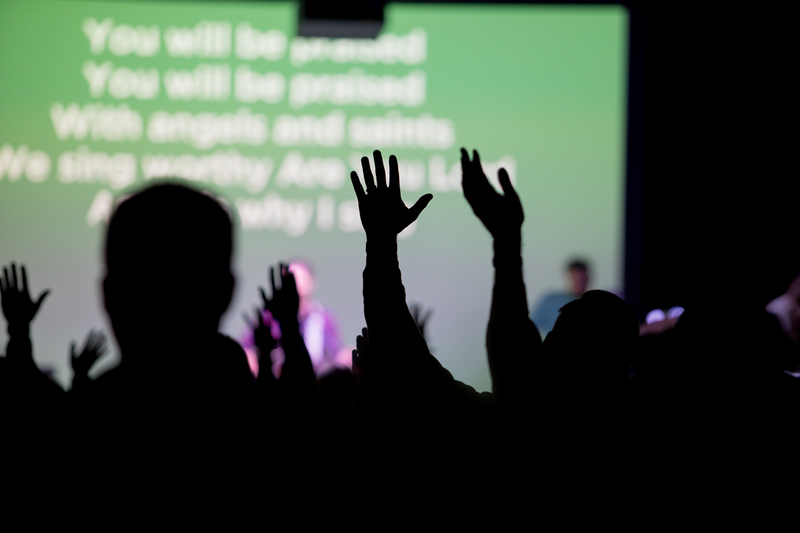
Swiping through my Facebook feed, I came upon a post that expressed regret of the fact that many churches are not using hymn books, and therefore, are not singing the old hymns in their services any longer. The presented idea suggested that many of today’s praise choruses and contemporary songs seriously lack solid doctrine, and with the departure of the old hymns from our churches, the rich theology they contain has also disappeared.
It is true that the lyrics of many of the old hymns were written by sound theologians and Christian leaders of years gone by, and can be full of doctrinal teaching and imagery from the Scriptures. And it is also true that many of the modern “7-11” songs and choruses are written by entertainers, and you can certainly end up unsure if those seven words the worship team keeps repeating are supposed to be directed to God or to a boyfriend/girlfriend.
For example, here is a sampling of some lyrics to a popular worship song written in the early 2000s:
You are my desire,
No one else will do,
‘Cause nothing else can take your place,
To feel the warmth of your embrace,
Help me find the way,
Bring me back to you.
You’re all I want,
You’re all I’ve ever needed.
You’re all I want,
Help me know you are near.
(Draw Me Close, words and music by Kelly Carpenter and Mark Hayes, © 2009 Integrity Music.)
There are a number of elements we could dive into to demonstrate the problem with singing these types of lyrics in a congregational worship setting, directed to God. But it’s fairly self-evident that the lyrics above can hardly be compared to singing:
I hear the Savior say:
“Thy strength indeed is small.
Child of weakness, watch and pray;
find in me thine all in all.”
Jesus paid it all;
All to Him I owe.
Sin had left a crimson stain;
He washed it white as snow.
(Jesus Paid it All, words by Elvina Hall, music by John Grape, public domain.)
If the first example is the sort of main-course lyrical diet that a church serves to its congregants week by week, I do not blame folks for leaving that church. I could not, in good conscience, bring my family to worship the Lord with the saints in that sort of setting. I believe the gathering of Christ’s Church each week is a form of warfare against the evil of this world, and the congregational singing is a major part of that. Rocking worship loops with romantic vibes about “sloppy wet kisses” from heaven (yes, that is actually in a modern “worship” song) and the like are probably not that much of a battering ram against the gates of hell. Probably.
It is important to remember that emotionalism is not the essence of Christianity. We must be singing about the great works of God, about His attributes, about His holiness and majesty, about His working in the lives of His people. The feelings of the worshipper should not be front and center. The Church must be armed with truth, not with feelings. Truth endures, feelings are fleeting.
However, I don’t mean that we categorically accept everything old, and reject everything new. Not at all.
Not all old hymns are great; we would do well to have some of them forgotten. There are the bulwarks such as How Great Thou Art, My Faith Has Found a Resting Place, Jesus Paid it All, A Mighty Fortress is Our God, Jesus Shall Reign, and so many others that you could name. But some of the hymns are weak in content, some are not easily singable as a congregation, and some simply teach wrong doctrine. Sometimes, expressions that would have been fitting one hundred years ago, are very strange (even funny or embarrassing) today. If you are singing lyrics such as, “The zephyrs seem to float to me, Sweet sounds of Heaven’s melody”, or “And when hoary hairs shall their temples adorn, Like lambs they shall still in my bosom be borne”… you may want to re-think your music program. Just because they are “hymns” in an old hymn book, or well-loved gospel songs, does not necessarily or automatically make them good.
Not all new songs are bad; some are tremendous. Are there are no carefully crafted, doctrinally rich songs of worship being written today? Yes, there certainly are! I have already mentioned some “bad” examples of modern worship music. But consider some true masterpieces such as O Church Arise, In Christ Alone, Not in Me, Behold Our God, The Power of the Cross, and many more still to be discovered and yet to be written.
I believe we should include the good old hymns in our services and hold them in high regard. This is especially important as we still have so many in our churches who have a lifetime of memories associated with them. And that is not something to be taken lightly.
And I believe we should also incorporate those new songs that are beautifully composed, singable as a congregation, fitting for worship of God in a congregational setting, and filled with rich doctrinal teaching and meaning. These are the important elements in choosing songs, not what is new and what is old. I am thankful to be part of a local church here in Illinois that sings the great old hymns, as well as some of the wonderful new songs of the Church.
As a side note, there are some who are arguing for a return of the church to singing the Psalms. There are some good options out there for this being done in a tasteful and singable way, and I personally love that idea.
It is very important that our churches be singing churches, and that they are vibrantly singing good songs. Often the melodies allow the messages of those songs to stay in the mind long after the Sunday sermon has been forgotten. Praise God that we have a rich heritage of powerful and meaningful songs from the past, and some dynamic, potent new songs being written today.
Oh to see the dawn of the darkest day,
Christ on the road to Calvary.
Tried by sinful men, torn and beaten then
Nailed to a cross of wood.

This the power of the cross.
Christ became sin for us.
Took the blame, bore the wrath,
We stand forgiven at the cross.

Oh to see the pain written on your face,
Bearing the awesome weight of sin.
Every bitter thought, every evil deed,
Crowning Your blood-stained brow.

Now the daylight flees, now the ground beneath
Quakes as its Maker bows His head.
Curtain torn in two, dead are raised to life.
"Finished!" the victory cry!

Oh to see my name written in the wounds,
For through Your suffering I am free.
Death is crushed to death, life is mine to live,
Won through Your selfless love!

This the power of the cross,
Son of God slain for us.
What a love, what a cost.
We stand forgiven at the cross.

The Power of the Cross, words and music by Keith Getty and Stuart Townsend, ©2005 ThankYou Music.

Get new posts by email
Discover more from Steve Hall
Subscribe to get the latest posts sent to your email.
 Steve Hall