Truthfully, I’ve never met a tool that actually does care about your feelings. But there are some tools that have garnered a reputation of being rather sinister, and radiocarbon dating is certainly in that category for many people in our day. Telescopes had this reputation in days gone by, which is briefly explained in a paragraph below.

Beginning with a Formal Admission
I must begin this post with an admission that I have no formal education or training at all with a science such as radiocarbon dating. Yet, here I find myself, with a degree in music and Bible, and a history in church ministry, in the comfort of my office on a cold December day, contentedly writing about dating methods in chemistry and physics.
Such are the ways of the Lord.
The main topic of this post is not radiocarbon dating itself. I mainly want to demonstrate the gift of tools, specifically scientific tools, that we have been given by God, and also to make a point about life, and the predictability of humanity. But I do hope that a lesson concerning radiocarbon dating will be gained by the reader as well, as I share a few things that I have learned.
An Attitude of Gratitude
Let’s begin with the attitude we should have for the tools at our disposal, which should really be an attitude of gratitude. We have so many blessings today due to the progress of mankind in the world.
God made men and woman, the crown jewel of His creation, and gave them the command to fill the earth and subdue it. In this story God is writing, He has given to mankind the responsibility of taking dominion over the creation.
Taking dominion over the creation is to involve our minds—our ingenuity, innovation, creativity, resourcefulness, talents, skills, etc. This is not something God has given to any other of His creatures to do, only sons and daughters of Adam. In the early stages of dominion-taking, this would mainly involve figuring out how to survive each day in this world. But as progress is made, and the world becomes more developed, we are freed from being consumed with our own survival alone, and begin to contemplate making life better for ourselves, our families, and for others. When our God-given minds begin to think, and wonder, and theorize about a certain something, we then have it within us to explore that something in order to figure it out and understand it. The main purpose for this exploration into the world is for the benefit of humanity, and ultimately, if all is as it should be, redounding to the glory of God, and bringing others into the Kingdom of Christ.
The Power of Tools
The way we make progress in our subduing of the earth and taking dominion is through the use of tools.
Mankind needs to solve a problem, but in order to fully solve the problem, he needs the right tools. Some tools are made for building, and some for learning. Man’s eyes are not made to see a human cell or an amoeba, so he needs a tool to do that with. At the same time, his eyes alone cannot make sense of the stars and the planets, so tools are invented to allow him to look into space. His hands are not strong enough to dig the foundation for a large skyscraper, or lift the materials thirty stories into the air, so he needs to develop tools that have that ability. His feet cannot carry him across the oceans to discover new worlds, so he makes tools that can carry him.
When we speak of “science” we are talking about the study of God’s natural world through observation and experimentation so that we may gain knowledge of this world we have been commanded to subdue. There are many tools that men have developed for this purpose. The purpose of these tools of learning are for the discovery of truth within the world.
The Problem with Tools
But the problem with tools is that they are unsympathetic and unrelenting. When working properly, they do their job very well, however, they don’t seem to care one bit about our feelings, emotions, or beliefs.
To put it another way, like all of God’s good gifts, tools can be dangerous. For example, if you are in the business of burning wood in a wood stove to heat your home, a chainsaw sure can be a handy thing to have around. But as helpful as that chainsaw is, there is certainly a dangerous side to it. It is up to the human who is employing the tool to know how to use it properly, and have a good understanding of it.
There are other kinds of “danger” with other kinds of tools. When it comes to tools that help us to learn and understand the world around us, there is always the risk that the tool is going to give us a very surprising, even shocking realization about something we thought we knew. It is potentially going to correct us where we have been quite wrong.
This is “dangerous” because it is hard for us humans to admit when we are wrong. It is especially hard when the information uncovered by the tool is unsympathetically destroying something I have believed with all of my heart, staked everything on, written books about, gotten invited to speak about, become a specialist in, and even possibly built a little kingdom around.
Consider the area of theology. There have been many times when man thought he knew something to be true about the world from the Bible, only to later discover through some scientific tool that his understanding was wrong. There was nothing wrong with the Bible, and there was nothing wrong with the tool, but the problem was in the understanding of men. This was famously demonstrated in the 1600’s when Galileo constructed his own telescope and began to peer into the heavens with his new tool (pictured above). The leaders of the day did not like what they were seeing as it did not agree with preconceived ideology, and Galileo himself even spent some time under house arrest as a result! Yes, tools can be dangerous.
It is at these moments that a very important (and hard) decision must be made. One choice we can make is to fold our arms, furrow our brows, and firmly plant our feet on what we have always believed, castigating anyone who would dare not do the same thing. The other choice would be to have the humility to admit that we do not know everything, and we should always take seriously any truth that is being revealed within the world. If God’s word is true, and the tools are being understood and used properly, then the only thing to fear is that I may have been wrong in my understanding of certain things. What we are after is truth.
The Example of Radiocarbon Dating
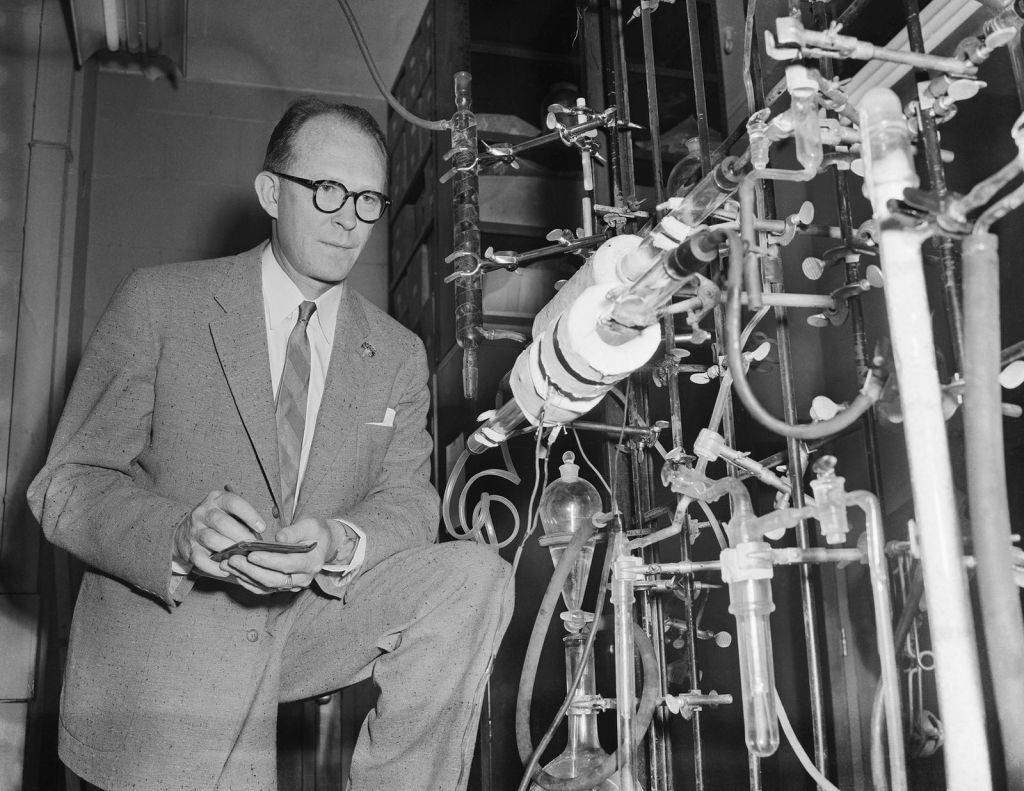
One of those tools that is a great example of this very thing is radiocarbon dating. In 1946, Willard Libby proposed a new method for dating organic materials by measuring their content of carbon-14, a newly discovered radioactive isotope of carbon. This method gives age estimates for carbon-based objects that originated from living organisms, such as human remains, animal remains, plants, leather, papyrus, logs from buildings, weaved baskets, grains, and so forth. One of the things this new tool began to do was give mankind the ability to much better understand archaeology and chronology, putting together an accurate history of humanity across the world and across time.
But here is where the problem comes in to play. The Bible seems to be clearly telling us that the world was created by God in six literal days, approximately seven thousand years ago. However, our new tool called radiocarbon dating is unsympathetically giving us measurements of years much longer than this. As a small example, you can Google information on a basket that has been dated to about 10,000 B.C., obviously placing its existence before the time of the creation of the world. You can research underground human dwellings that have been located and dated to long before the approximate date of creation. And that’s just a drop in the bucket.
So what do we do with this difficulty? Well, here are the two things that we certainly should NOT do, and that is to simply throw one of the two out the window. Some will lose all faith in what God’s word is telling us, and toss it in the category of myth and fairy tale like any other ancient legend. Others will throw out the science and the tools of learning as foolish distractions, as they plant their feet firmly on their understanding of the Word of God.
Taking a High View of God’s Word and God’s World
How we so easily forget that both of these things belong to an infinite God. And if this is true, there is eventually going to be a reckoning between these points of tension. It may (will) take us some time to understand it, but the goal ought to be just that—to seek to understand it. With a high view of both God’s word and God’s world, we should take up the task of searching out God’s wonders and figuring things out, just as He would have us do.
I am not going to go into the answer for the question about the age of the earth that has been presented in this article. There are good Christians who have been working on this question for a long time. In our December, 2023 podcast, Jennifer and I discuss what I believe is the best answer to this conundrum. I hope you will head on over there and listen to that. Also, our next podcast (January, 2024) is going to address radiocarbon dating in more detail.
Let’s be thankful for the tools God has allowed men to discover in order to search out His truth in this world. Even those unsympathetic ones.

Get new posts by email
Discover more from Steve Hall
Subscribe to get the latest posts sent to your email.
 Steve Hall
One thought on “Tools That Don’t Care About Our Feelings (like Telescopes and Radiocarbon Dating)”