🎧 Listen to the article:
Have you ever been thirsty? Really thirsty? When you are thirsty you want water. A soft drink or glass of tea would be better than nothing, but water is what you really crave, and what you really need.
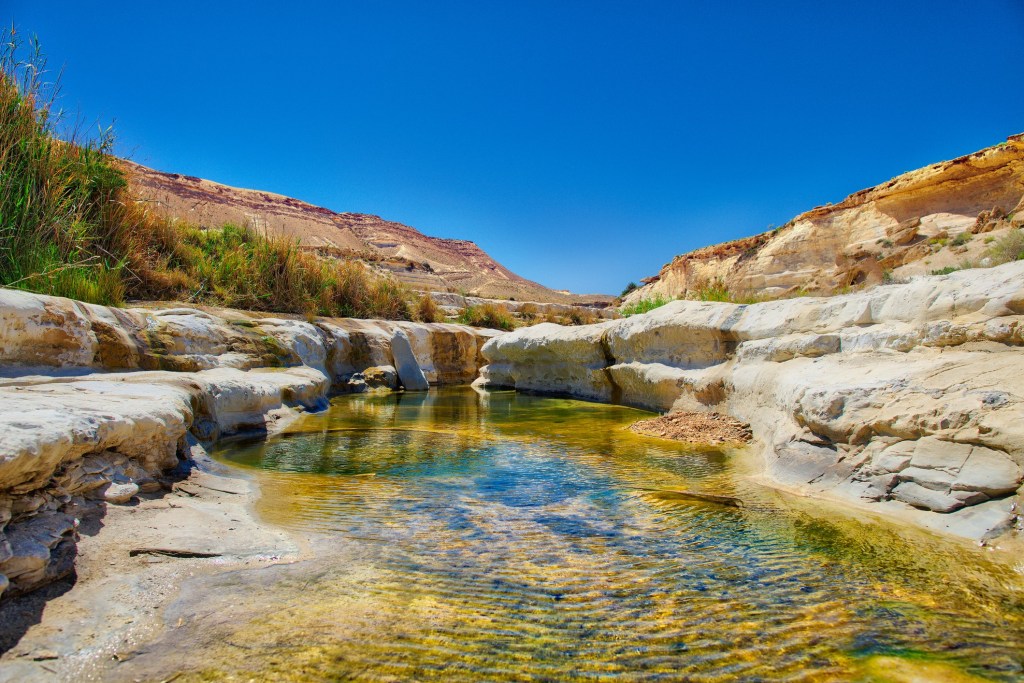
This article begins a small series of posts looking at some of the biblical events from the Old Testament. With the corrected chronology, we see how these stories actually occurred in the real world, giving us an even better understanding of the Author behind them.
In this first installment of a two-part post, we will look at a place told of within the biblical story of the Exodus; a place where the Children of Israel were very thirsty. The place is called Rephidim, and here it is said that the Lord provided water for His people in an amazing way. The Exodus is a remarkable account in Scripture, with some wild narratives of God’s provision for His people in the wilderness. And the story of Rephidim is no exception.
You are likely not familiar with the name Rephidim. You have probably never told anyone, “My favorite Bible stories are those that took place at Rephidim.” But if you are at all familiar with Bible stories, you probably have heard of the events said to have taken place there. Here is a brief rundown.
The nation of Israel has exited Egypt following the terrible plagues. They have seen God bring them out from under the hand of mighty Pharaoh, lead them through the wilderness by a pillar of fire and cloud, and destroy their enemies in the Red/reed sea. Now they are on their way toward Mount Sinai.
This massive group of millions of people and their livestock have made various stops along their journey, and just before arriving at Mount Sinai, we read in Exodus 17 that they arrive at this location the Bible calls Rephidim.
At Rephidim the people are thirsty. They begin to quarrel with the leadership about the fact that they have no water to drink. It is easy to condemn the Israelites for complaining, and they certainly did end up with serious consequences for it. But when you think through the scenario, it definitely would have been a challenge to your faith. Especially if you had little ones and a family that depended upon you. I imagine it would not have taken long for panic to begin to set in, out in that dry and hot wilderness. Remember, as far as we know, there were no convenience stores or road way rest stops along their journey. Just them and the wide open wilderness in front of them.
And God.
The Lord had already demonstrated His awesome power and ability to provide for them, and they were expected to learn this lesson along the way. This complaining by the Israelites becomes a habit in the story, even as their faith should have grown tremendously in the Lord. They ask Moses why he has brought them up out of Egypt just to kill them all with thirst in the wilderness, along with their children and livestock. They are exceedingly thirsty, and they are angry. According to Moses, some were ready to stone him. So Moses cries out to the Lord for guidance.
God then commands Moses to do a strange thing. He tells him to take his staff, the same staff he struck the Nile river with back in Egypt, and go where He indicates. God says, “Behold, I will stand before you there on the rock at Horeb; and you shall strike the rock, and water will come out of it, that the people may drink.”
Moses does what God says while all of the elders of Israel look on, and, as God had said, water comes forth for the Israelites to drink. Out of rock. (There are a couple of other well-known events that took place in Rephidim, but in this article we are focusing on the familiar story of water from the rock.)
‘Behold, I will stand before you there on the rock at Horeb; and you shall strike the rock, and water will come out of it, that the people may drink.’ And Moses did so, in the sight of the elders of Israel.
Exodus 17:6
Now that we are more acquainted with Rephidim and what took place there, we will see how corrected chronology gives a whole new take on this story, making it come alive in the real world. We are seeking to identify the actual location of the place the Bible calls Rephidim and thereby see if, by finding the actual location in the real world, we can learn anything further about what is told to have transpired there. Then, in part two of this article, we will draw some spiritual life lessons from this account.
I’m going to tell you something about the “water from the rock” story that you have never heard before. And the reason you have never heard it before is because we never knew it before. And we did not know it before because we did not know where the location of Rephidim was. And we did not know where it was because we have been looking at the wrong dates—we had the wrong chronology. When you get the dates right, it’s amazing what comes to light. The story of Rephidim is a great example of this.
If millions of people and all of their livestock truly wandered around the Sinai Peninsula for forty years, there should be some evidence of these people being there, and the evidence should demonstrate the route they took. Specifically, there should be pottery. Not just any pottery, but pottery of the right time and type that identifies it as “Exodus pottery.” Looking at the traditional date of 1450 BC, we find no evidence of the Exodus of the Hebrews. That’s not to say there is no pottery to be found. But a great deal of what has been found during archaeological surveys seems to be way too old to be our “Exodus pottery.” And this has caused a lot of heart burn (to say the least) for those in the modern world who have tried to defend these ancient biblical accounts as true stories. But when you get the dates correct, and, as Dr. Gerald Aardsma, the Biblical Chronologist has taught us, you move the events back 1000 years to 2450 BC, the evidence is right there for all to see.
Below is a map of the northern section of the Sinai peninsula, and where our modern, corrected chronology brings to light the locations of key places within the Exodus account. With the correct dates, the pottery and other archeological finds lead us like an ancient map through the wilderness to previously unknown places such as Succoth, Etham, Pi-hahiroth, Rephidim, all the way to Mount Sinai and beyond.
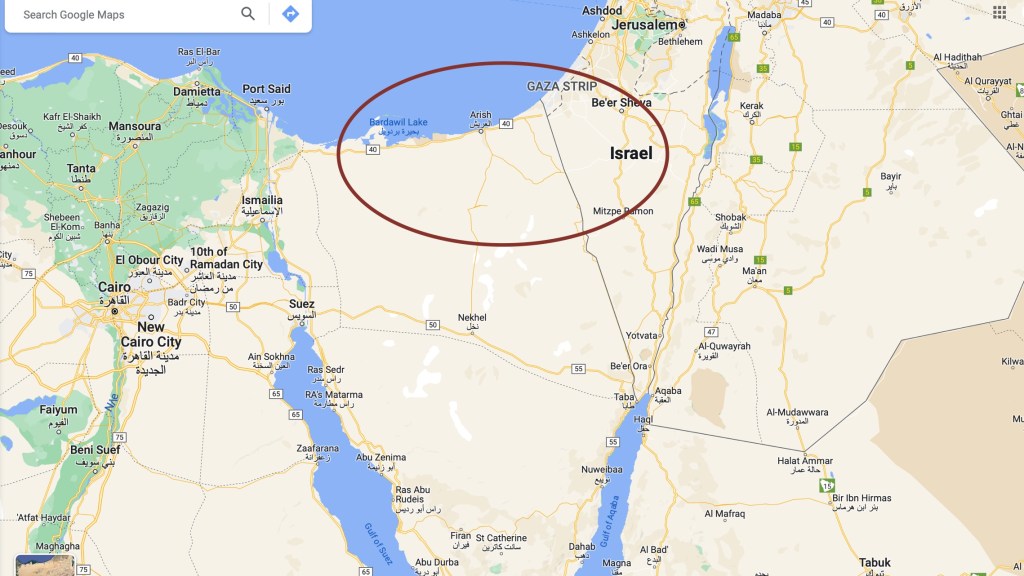
Zoomed out view of the Sinai Peninsula on Google Maps for reference. 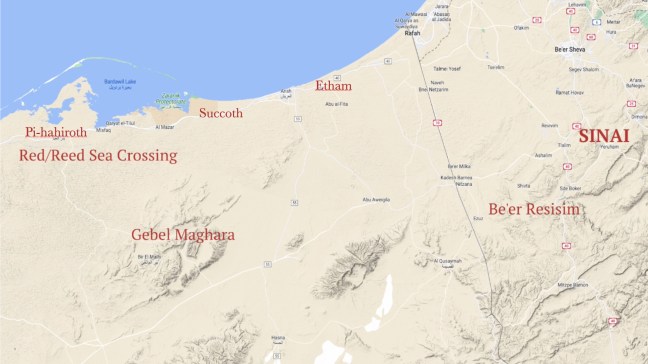
Map of northern Sinai peninsula showing various encampments of the Israelites within the Exodus account.
We cannot just pick any location we want and claim that we have found a place like Rephidim. This has been tried ad nauseam when it comes to Mount Sinai. We cannot find a mountain that has a black top and proclaim that it must be Mount Sinai because, I mean, it has a blackened top… obviously where the Lord came down upon it. We cannot find a large imposing rock that has a very large crack down the center of it and proclaim it to be the very rock that the water must have flowed out of. Even if the large rock with the crack in it is right beside the mountain with the black top.
This is not the way stories are found in the real world. Imagine someone a few thousand years down the road from today finding some documentation on the establishment of the George Washington National Forest and thereby concluding that obviously this was when George Washington must have lived because, see, he established a national forest. That mis-guided interpretation would have Washington living in the mid 1990s.
Of course, to us that is a ludicrous thought. But it demonstrates the importance of correct chronology. You can really get into a mess of wrong ideas about events in the past if you get the dates all wrong. Certain requirements must be met in order to find the correct places for events described in the Bible. Having the correct dates lead us to the evidence (or lack of evidence) to locate the event in the real world. Correct chronology might sound dry and boring but, oh, the places that it leads.
When the dates are corrected in the Exodus account, the trail of pottery leads you to a low lying mountain that is the true Mount Sinai. The guessing game is over. The true Mount Sinai today is called Mount Yeroham. You could look it up on Google maps right now if you wanted to. The Bible then gives us the information that Rephidim was one day’s journey from Mount Sinai, so this is another piece of the puzzle that needs to fit into place.
When all of these things come together with the correct chronology—the trail of pottery, evidence of people groups described in Scripture, proper distance from the true Mount Sinai, etc.—we are led by modern archeology to another place you can find on modern maps today called Be’er Resisim. And on top of all of this good evidence, need I mention that even the phonetic similarity in the names Resisim and Rephidim surely must be more than coincidence.
The word Be’er means “well.” So Be’er Resisim means “the well at Resisim” or, “the Resisim well.” Here we have the first indication of… water. Let me briefly explain some things about this place concerning water. And rocks.
At Be’er Resisim, we not only have a modern day well, but there is also near-surface water underneath a layer of rock in this region. The physical features of the surface of the ground of Be’er Resisim uniquely exhibits this characteristic.
Archaeologist William G. Dever states, “Be’er Resisim was located at precisely the one point along the wadi (a ravine or channel that is dry except in the rainy season) where the water-bearing shale layers rise to within 3m of the surface. The modern well that gives its name to the site is located here, where even the shallow pits (tumili) dug by Bedouin can easily reach water.” 1
Of course some things will have changed over thousands of years, such as the accumulation of sediments. But to understand the significance of this “water-bearing shale” described by the archaeologists and how it correlates with the Bible story, we need to understand a little about ground water. Here is the most important thing to know in the present instance:
“Groundwater in aquifers between layers of poorly permeable rock, such as clay or shale, may be confined under pressure. If such a confined aquifer is tapped (for instance, by a well), water will rise above the top of the aquifer and may even flow from the well onto the land surface. Water confined in this way is said to be under artesian pressure, and the aquifer is called an artesian aquifer.” 2
You may have heard of an artesian well.
The basic idea is that water is bubbling up to the surface, seemingly of it’s own accord, but is actually under natural pressure from the hills flanking it.
Dr. Gerald Aardsma describes it this way, “Artesian pressure results when water soaks into the ground at higher elevations (on hills, for example) and is subsequently trapped under impermeable layers at lower elevations (in valleys, for example). Nahal Resisim (i.e., the seasonal Resisim River) is flanked by hills. Meanwhile, its bed contains impermeable shale layers. This immediately suggests the possibility that it was water-bearing shale in the Nahal Resisim (dried up river bed, or wadi) which Moses struck with his staff, fracturing it and allowing water trapped under artesian pressure to come out of it.” 3
If this is correct, then the miracle being recorded here is not that water was made to come from nowhere and flow out of a dry rock, but rather appears to be that God told Moses precisely where to find this water and how to get at it:
“… I will stand before you there on the rock…; and you shall strike the rock, and water will come out of it, that the people may drink.”
This seems clearly to be saying that God will stand on the specific rock that Moses should strike, and when the rock is struck water will come out. And, of course, that is what happened. It is interesting to think of the possibility that the well that still exists at Be’er Resisim today could be the very spot where Moses struck the rock.
In conclusion— Moses, following God’s leading, brought water from the rock at Rephidim. Placing the Exodus at the corrected date of 2450 BC leads us to Be’er Resisim as the location where this event happened in the real world. And in this very place, even today, we find the highly unique feature of water underneath rocks, under artesian pressure, there in the dry and barren desert of the central Negev.
We can see for ourselves the evidence of real people with real thirst, real rocks concealing real water that bubbled to the surface when the rock was struck…. And most of all, a very real God, who is just the same today.
[In part two of this article we discuss the miraculous nature of this account, and how it applies to our lives today.]
[Be sure to check out Dr. Gerald Aardsma’s original Biblical Chronologist newsletter article, The Route of the Exodus, Part IV: The Identification of Rephidim.]
[Here is audio of me preaching on the topic of Rephidim at our home church– God’s Sovereign and Miraculous Leading.]

Subscribe to receive new posts in your inbox.
Footnotes
- William G. Dever, “Be’er Resisim,” The New Encyclopedia of Archaeological Excavations in the Holy Land, vol. 1 (New York: Simon & Schuster, 1993), 158.
- usgs.gov/special-topics/water-science-school/science/ aquifers-and-groundwater (accessed March, 2, 2023).
- Gerald E. Aardsma, “The Route of the Exodus, Part IV: The Identification of Rephidim,” The Biblical Chronologist 13.3 (March 14, 2023): http://www.biblicalchronologist.org.
Discover more from Steve Hall
Subscribe to get the latest posts sent to your email.
 Steve Hall
2 thoughts on “Water from the Rock in the Real World (part 1)”